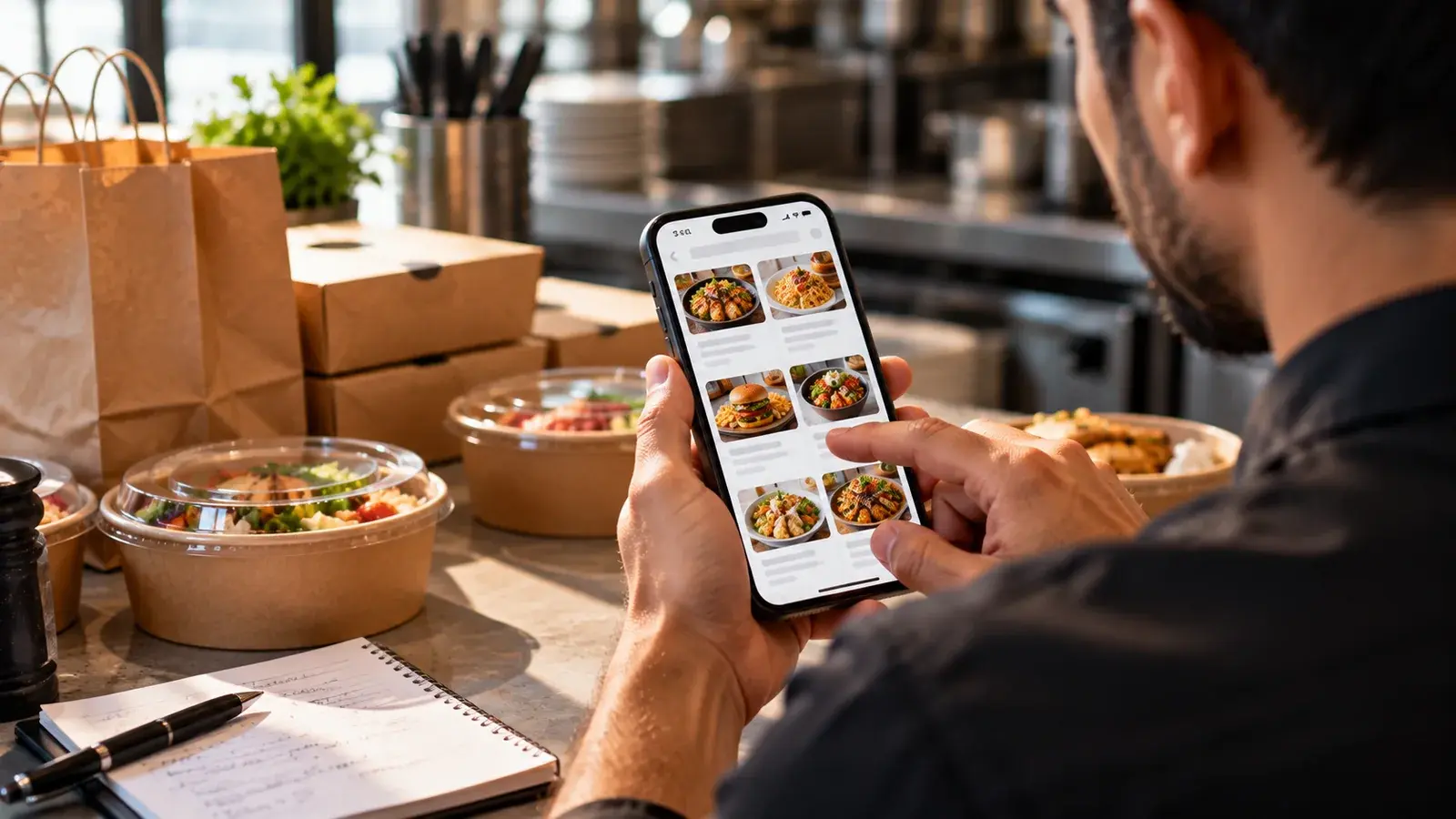
Your restaurant shows up in the app. Customers tap in, scroll the menu, and leave without ordering. The short answer: views and orders are separate steps, and something between them is putting people off.
If customers are opening your page, visibility has already done its job for that step. The problem sits on the page or behind it: the menu, the price at checkout, trust signals or availability. Check the page before you change anything or pay for more visibility.
Views, visits and orders are different numbers
Impressions are the times your restaurant appeared to a customer, for example in a list or search result. Page visits (often called views or menu views) are the times a customer opened your page. Orders are completed orders. Conversion rate here means orders divided by page visits. Orders divided by impressions is a different measure.
If your dashboard shows orders but not visits, you cannot work out a true conversion rate from order counts alone, and a drop in orders could mean fewer visits or fewer visitors ordering. Use the same outlet, period and basis for both figures. Advert reports are different: Deliveroo’s help centre says its advert report counts only menu views that came from the advert, and orders placed within 7 days of a click, so it is not your restaurant-wide conversion rate.

Is it a traffic problem or a conversion problem?
An illustrative example with round numbers. It is not a UAE industry benchmark or a promise of results.
| Page visits | Conversion rate | Orders | |
|---|---|---|---|
| Today | 5,000 | 3% | 150 |
| After a menu fix | 5,000 | 4% | 200 |
One percentage point more conversion brings 50 more orders, about 33.3% more from the same traffic. Reaching 200 orders at 3% would take roughly 6,667 visits, about 1,667 more. Check the page before paying for more visibility, and watch order margin as well as order count.
What your dashboard may show
Platforms do not all report the same things. As checked in October 2026, public merchant documentation describes:
- Deliveroo: Hub Reports with a menu conversion metric, open rate, rejected orders by reason and average rating, plus separate advert reports.
- Careem, noon Food, Talabat: partner dashboards or portals covering items such as menus, hours, sales, finances and, for Talabat, “data insights”. No conversion metric is listed.
- Keeta, Smiles: no public documentation of visit or conversion reporting was found.
Reports can depend on your market and account type, so ask your account manager what visit data exists for you. If none does, track orders by week, ratings, cancellations and hours offline.
Your menu is the sales page
A delivery customer cannot ask a waiter what is in a dish or how big it is, so the page has to answer for you.
Photos. noon Food’s UAE guidelines require good-quality item images and do not accept blurry, cropped or black-background photos, or images with text or logos. Deliveroo tells advertisers with many menu views but few orders to add photos and descriptions to every item. Nobody can promise a specific uplift, so treat it as a test and show the food as the customer will receive it.
Names and descriptions. Deliveroo’s menu guidance says only the first 60 characters of a description show on the menu page, so put the main ingredients and size first. “Large mixed grill, serves two: lamb kofta, chicken tawook, rice, grilled tomato” answers more than “Chef’s special”. noon Food also requires item names and descriptions in both English and Arabic.
Categories and bundles. Deliveroo suggests roughly 40 to 80 items, excluding options, and says bundles can raise average order value. noon Food prefers main categories near the top and drinks not first. Group items so a customer can build a full meal without opening five categories. See our guide to menu engineering for food delivery apps.
What the customer sees at checkout
Customers pay the total, not the item price, and fees shown at checkout can change a decision made on the menu page. Baymard’s research on US online shoppers found extra costs at checkout, such as shipping, tax and fees, were the most common reason for abandoning a cart, at 40% (not counting shoppers who were just browsing). That is US online retail, not UAE food delivery, so treat it as general behaviour only.
Place a test order on each app, at lunch and at dinner, and compare the total with the item prices. Prices across apps matter too: noon Food’s guidelines require prices no higher than on other aggregators, and Careem says delivery prices above a restaurant’s own menu or other platforms could lead to removal. Terms vary by agreement, so check your own.
Trust: ratings, reviews and delivery experience
When two restaurants look similar, ratings and recent reviews can help a hesitant customer decide. How any platform weighs ratings in its ranking is not something this article claims to know. Read your recent reviews and sort the complaints: food quality, temperature or packaging, missing items, delays. A repeated complaint is a likely reason people hesitate. Careem also tells partners to accept orders promptly, warning that delays can lead to bad ratings and reduced orders. For a step-by-step process, see our guide to improving restaurant ratings and reviews on delivery apps.
Operational gaps that quietly cost orders
A customer who finds you closed, or the dish they wanted unavailable, has little reason to stay. Deliveroo reports an “open rate” comparing actual with expected opening hours, and Careem’s dashboard lets you check hours and mark items unavailable. Check hours for every outlet and take never-in-stock items off the menu.
Look at rejections and cancellations too. Repeated reasons such as “out of stock” or “too busy” point to menu accuracy and capacity, not marketing. noon Food shows average preparation time to customers and calls it an important decision factor, so set it honestly.
Your 7-Day Delivery App Conversion Improvement Checklist
Fix plain errors immediately, then change one thing at a time. These days are for diagnosing and starting improvements, not a promise of measurable results within the week.
- Day 1: record four weeks of orders by week for each platform and outlet, plus rating, cancellations, hours offline and visits if available.
- Days 2–3: open each app as a customer at lunch and dinner. Fix opening hours, remove always-unavailable items, set a realistic preparation time, and note best-sellers without photos or clear descriptions.
- Day 4: place a test order on each app and note the total, fees and price differences.
- Day 5: list the three most repeated complaints and fix what is operational.
- Day 6: choose one menu change, such as new photos and clearer descriptions for your ten best sellers. Careem’s FAQ gives an expected timeline of 7 working days for menu changes, so submit early.
- Day 7: set a review date two to four weeks after the change goes live, or longer if volume is low.
How to tell whether it worked
Compare like with like: the same weekdays, outlet and platform, avoiding promotions, public holidays or Ramadan unless the baseline covers them. If visits are available, compare conversion; if not, compare orders, ratings and cancellations. Then check the margin: more orders at a lower profit per order may not improve your month.
Frequently asked questions
What is a good conversion rate for a restaurant on a delivery app?
We found no verified UAE benchmark. Rates differ by cuisine, area and time of day, so compare each outlet with its own past weeks.
How do I calculate my conversion rate?
Divide orders by page visits for the same outlet and period, then multiply by 100. For example, 150 orders from 5,000 visits is 3% (an illustrative figure). Without visit data you cannot calculate it from orders alone.
Do all delivery apps show conversion data?
No. Deliveroo documents a menu conversion metric. The other platforms’ public pages did not list one at the time of writing, so ask your account manager what exists for your account.
Getting views but not enough orders?
If you have worked through the checklist and still cannot see where orders are leaking, Secret Sauce can help you identify the gaps through a Restaurant Delivery Performance Audit. It is a one-time review of how your menu, pricing, campaigns and platform performance may be affecting conversion, followed by a prioritised action plan. Ongoing support is available if you want help putting it into practice.
We are a restaurant growth agency working with UAE restaurants across Talabat, Noon Food, Deliveroo, Careem, Keeta and Smiles. Contact us at hello@secretsauce.ae. More Orders. Better Margins. Smarter Growth.